If you've spent any amount of time in homeschool groups, you've probably seen the question asked in one form or another.
"What if I'm not teaching enough?"
"What if my child falls behind?"
"What if I miss something important?"
"Will they be able to get into college?"
"What about transcripts and diplomas?"
"How do I know they're getting everything they need?"
These questions come from parents who care deeply. In fact, they're often asked by the very parents who are pouring countless hours into researching curriculum, reading books, adjusting lesson plans, finding local resources, and wondering if they're doing enough.The truth is, nearly every homeschooling parent wrestles with these thoughts at some point.
The good news? These fears are incredibly common and most of them have practical answers.
One of the biggest misconceptions about education is that there is only one "right" way for children to learn. Many of us grew up believing that learning had to happen in a classroom, with a teacher standing at the front, subjects divided into neat blocks of time, and progress measured by tests and report cards. Because that's the system most of us experienced, it's easy to assume it's also the standard every child must follow, but education is much bigger than a building. Long before schools looked the way they do today, children learned by observing, asking questions, practicing skills, solving problems, creating, reading, discussing, exploring, and participating in everyday life. Learning has always been part of being human.
Homeschooling doesn't remove education from a child's life, it simply changes where and how it happens. Which still requires planning, flexibility, and patience ; but it also allows education to become something that fits the child instead of asking the child to fit the system.
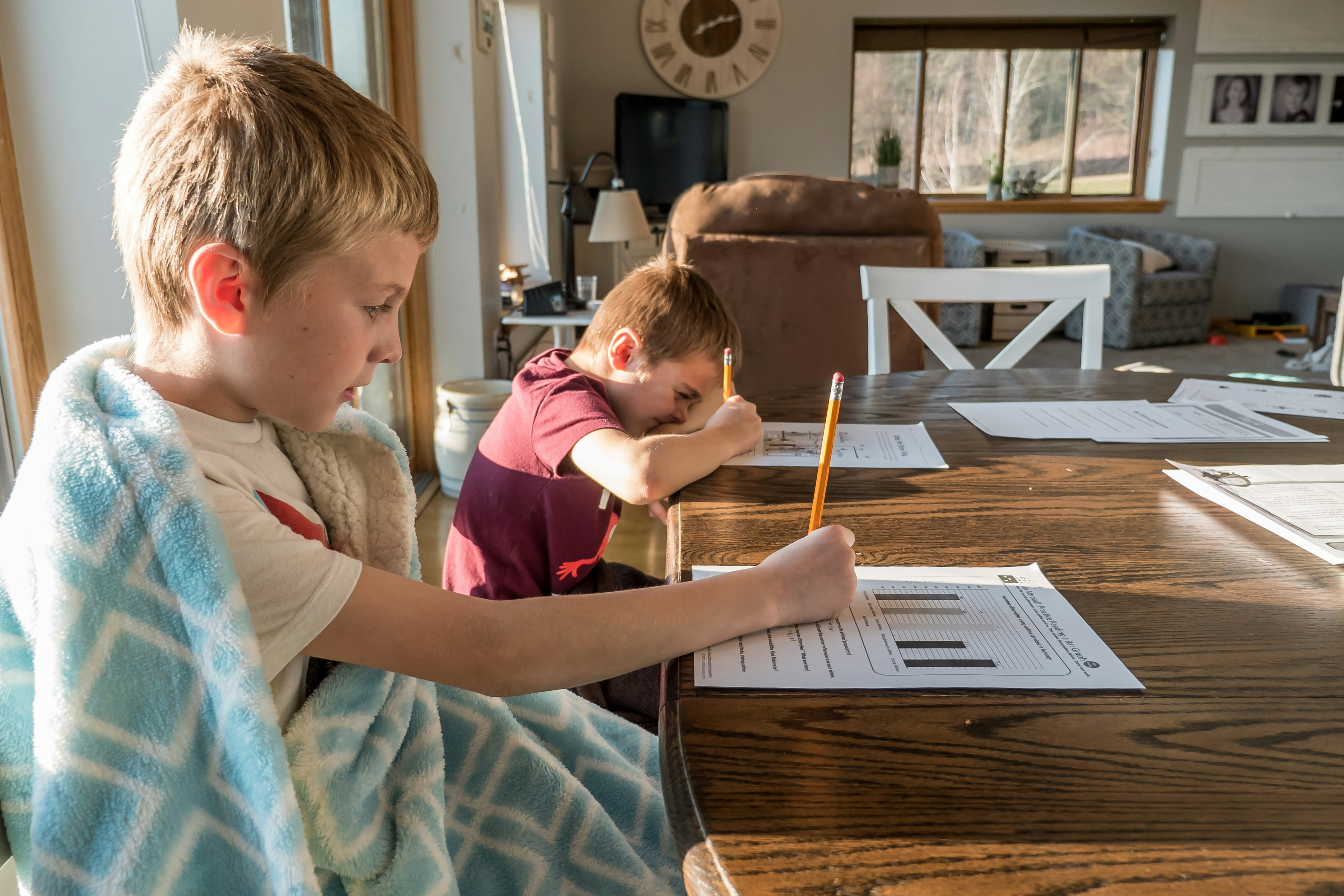
The Freedom To Learn
One fear that surfaces again and again is the worry about "missing something."
Which is completely understandable. No parent knows everything. Teachers in the public school system, don’t know everything either. And give yourself some credit! You are a parent and teacher while also teaching all subjects and life. You are a hustler!
The true reality: no educational setting teaches absolutely everything. But what you feel is important to teach, will be taught!
Public, private, and even charter schools all make choices about what to include. Every curriculum publisher decides what deserves more pages and what deserves less or even what kind of teaching is taking place. Even teachers with years of experience don't have unlimited time to cover every topic in every subject. Education has never been about knowing everything. It has always been about learning how to learn.
Side Note: If this idea resonates with you, I recently discovered SelfLearners, a program that focuses on teaching teens how to learn rather than simply what to learn. It aligns beautifully with the philosophy we've been talking about here. Learn More: https://selflearners.io/
One of the greatest strengths of homeschooling is that when a gap is discovered, you can simply...learn it. If your child suddenly becomes fascinated with astronomy at eleven years old, you can spend weeks exploring space. If fractions don't click until later, you can slow down without worrying about your child properly learning, and absorbing the information, or being rushed to keep up with a classroom of 25 other kids. If reading comes earlier than expected, you can move forward. If it comes later, you can provide more support without comparing your child to an entire classroom.
Learning isn't a race. It's a journey that looks different for every child, and as a homeschooling parent, you are giving your children room to flourish, grow, and learn at their own pace.

What About College?
Another common concern is whether homeschooled students can attend college.
The answer is yes!
In fact, colleges have been accepting homeschooled applicants for decades. Many admissions offices are familiar with homeschool transcripts and often appreciate the independence, initiative, and self-motivation that homeschool students develop along the way. Homeschooled graduates attend community colleges, trade schools, universities, military academies, online programs, and graduate schools every year.
The path simply looks a little different.
Instead of receiving records from a school district, parents typically create and maintain educational records themselves. This may include attendance records if required by state law, course descriptions, grades if you choose to assign them, reading lists, volunteer work, extracurricular activities, standardized test scores when applicable, and eventually a high school transcript.
That sounds intimidating at first, but remember high school transcripts aren't something you need to figure out when your child is five years old. Like everything else in homeschooling, you learn each step as you reach it. Many homeschool organizations, state associations, curriculum providers, and experienced homeschool families offer templates and guidance when those high school years arrive. The same is true for diplomas. In many states, parents who homeschool legally are able to issue their child's homeschool diploma upon graduation, while some families choose umbrella schools or accredited programs depending on their goals and state requirements. The process varies by location, which is why it's important to become familiar with your own state's homeschool laws, but countless families successfully navigate graduation every year.
Comparison: the Killer of Joy
Sometimes the biggest pressure isn't legal requirements or college admissions.
It's comparison.
Scrolling through social media can make it seem like everyone else has color-coded lesson plans, spotless homeschool rooms, children happily completing independent work, and elaborate science experiments every Tuesday afternoon.
Real life rarely looks like that.
You know it, I know it, we all know it. If you find yourself asking: “how?” there is probably more behind the scenes than you are aware of. It’s silly to compare our children or selves to others because everyone struggles in their own way. Learning is not a race. It is an experience. Every journey is different and that is perfectly normal!!
Real homeschooling looks like reading on the couch because everyone slept in. it looks like math at the kitchen table while eating a messy snack, it looks like taking a nature walk because everyone needed some fresh air, or perhaps changing the plan because your child had questions that deserved more time. And that is the beautiful luxury of homeschooling. We have the choice to dive deeper, think longer, come back to places we struggle in at a later time.
Some days, it looks like tears, or laughter. Sometimes lessons click right away, others take months. All of it is completely normal, and you are doing the best you can! Taking the chance and opportunity to homeschool your children is already one step in the right direction at providing a secure, resilient, and versatile child! Children are not machines programmed to master every concept on a predetermined timeline. Growth happens in spurts. Skills develop unevenly. One child may read early but struggle with handwriting. Another may build incredible mechanical skills before becoming interested in writing stories. Human development has never followed a perfectly straight line.
Perhaps one of the greatest gifts homeschooling offers is the ability to recognize your child's unique strengths instead of measuring them against a single standard. Reading, writing, mathematics, science, history, communication, critical thinking, and problem-solving all matter.
But so does curiosity, creativity, empathy, resilience, confidence, responsibility, time management, financial literacy, learning to cook a meal, how to do daily tasks, how to properly take care of their bodies, asking thoughtful questions, build meaningful relationships, and so on. These are not “extra” skills either, these are things that we carry with us into adulthood. Sometimes I laugh at how much I struggled in certain topics in public school, and felt so much pressure to get right, just to never look at it again past school aged years. But, have lacked major skills that I did need for adulthood. Children need knowledge, but they also need wisdom. They need opportunities to practice what they learn in real life, not only on paper.
If you're feeling overwhelmed today, take a deep breath and zoom out. You are not expected to recreate an entire school system inside your home. You are building something different. You are creating an education that grows alongside your child. Those moments add up more than you realize.
Will you make mistakes?
Absolutely.
Every parent does, every teacher does, every school does. The goal isn't perfection. The goal is progress. Your child doesn't need a parent who knows every answer. They need a parent willing to learn alongside them, and to be taught “how” to learn, how to engage, and enjoy the process of it all. Because life itself is the best school.
And if you're reading this because you've been lying awake wondering whether you're enough for this journey, let this be your reminder:
The fact that you're asking these questions says far more about your commitment than your shortcomings.
The lessons they'll remember most won't always be the ones found in a textbook. They'll remember the books you read together on rainy afternoons, the conversations sparked by their endless questions, the confidence you built by believing in them, and the feeling that learning was something your family did together; not something that only happened inside four classroom walls.
That is an education worth giving.
And if you keep showing up with love, curiosity, and a willingness to grow, chances are you're already giving your child far more than you realize. Love you always!! Keep rocking this homeschooling thing, while also being the best parent you can be! You are a superhero! Give yourself some more credit!♥